
Quick Answer: Mercury outboard diagnostics on modern FourStroke, Verado, and ProXS motors require CDS (Computer Diagnostic System) and/or VesselView access — Mercury’s proprietary diagnostic software that communicates with the Mercury ECM and SmartCraft network. Generic automotive OBD tools cannot read Mercury Marine ECM fault codes. Certified Marine Outboards carries CDS equipment and runs a full network diagnostic as the first step on every South Florida Mercury service call.
How Mercury Outboard Diagnostics Work: VesselView, SmartCraft, and CDS Explained
South Florida Mercury outboard owners whose motors have been returned from shops with “couldn’t find anything wrong” on the report have almost certainly encountered a mechanic without CDS access. Here is what the correct Mercury diagnostic process looks like.
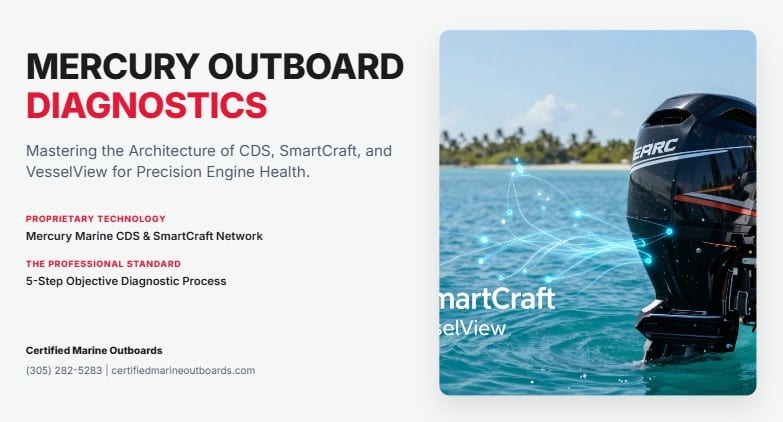
Mercury’s Diagnostic Architecture: CDS, SmartCraft, and VesselView
Mercury’s diagnostic system has three interconnected layers. CDS (Computer Diagnostic System) communicates directly with the Mercury ECM to read fault codes and live sensor data. SmartCraft is Mercury’s network protocol connecting the ECM, gauges, helm controls, and trim system — all sharing data across the CAN network. VesselView is Mercury’s helm display that shows SmartCraft data; it can be used as a diagnostic reference but does not replace CDS for professional diagnosis. Ryan carries CDS diagnostic equipment that communicates with all three layers.
The Diagnostic Process at Your South Florida Location
Step 1 — CDS connection to Mercury ECM. The CDS interface connects to the Mercury diagnostic port under the cowling. Connection and software identification take two minutes. CDS reads all stored fault codes across the SmartCraft network.
Step 2 — Fault code review and live data monitoring. CDS displays Mercury fault codes in plain language: “Low Fuel Pressure,” “Engine Overheat,” “Trim Sensor Fault,” “Supercharger Boost Pressure Low” (Verado). Live data monitors fuel pressure, coolant temperature, boost pressure (Verado), trim angle, and charging voltage in real time during cranking and running.
Step 3 — Component tests. CDS enables actuator tests — individual injector activation, throttle position sensor validation, trim motor test — that distinguish sensor faults from mechanical faults without physical disassembly.
Step 4 — Verado supercharger pressure monitoring. For Verado motors, CDS monitors boost pressure at the supercharger outlet and compares it against the specification. A degraded supercharger producing below-spec boost is identified from live data before any physical supercharger inspection is needed.
Step 5 — Post-repair CDS confirmation. After every Mercury repair, CDS confirms fault codes have cleared, and all live sensor data is within specification. This is the objective confirmation that the repair addressed the actual fault.
South Florida Mercury owners who have been told “we couldn’t find the fault” by shops without CDS know, by contrast, what an accurate Mercury diagnosis feels like. Every Certified Marine Outboards Mercury call starts and ends with CDS. Call (305) 282-5283 | certifiedmarineoutboards.com