
An overheat alarm is the most serious sound your outboard makes. Not because the alarm itself is dramatic, but because of how little time you have between hearing it and doing permanent damage.
Most engine problems tolerate being finished later. Overheating does not. An engine that runs hot for a few minutes can lose a powerhead, and the cost of that outcome is measured in thousands rather than hundreds.
What the Cooling System Is Doing
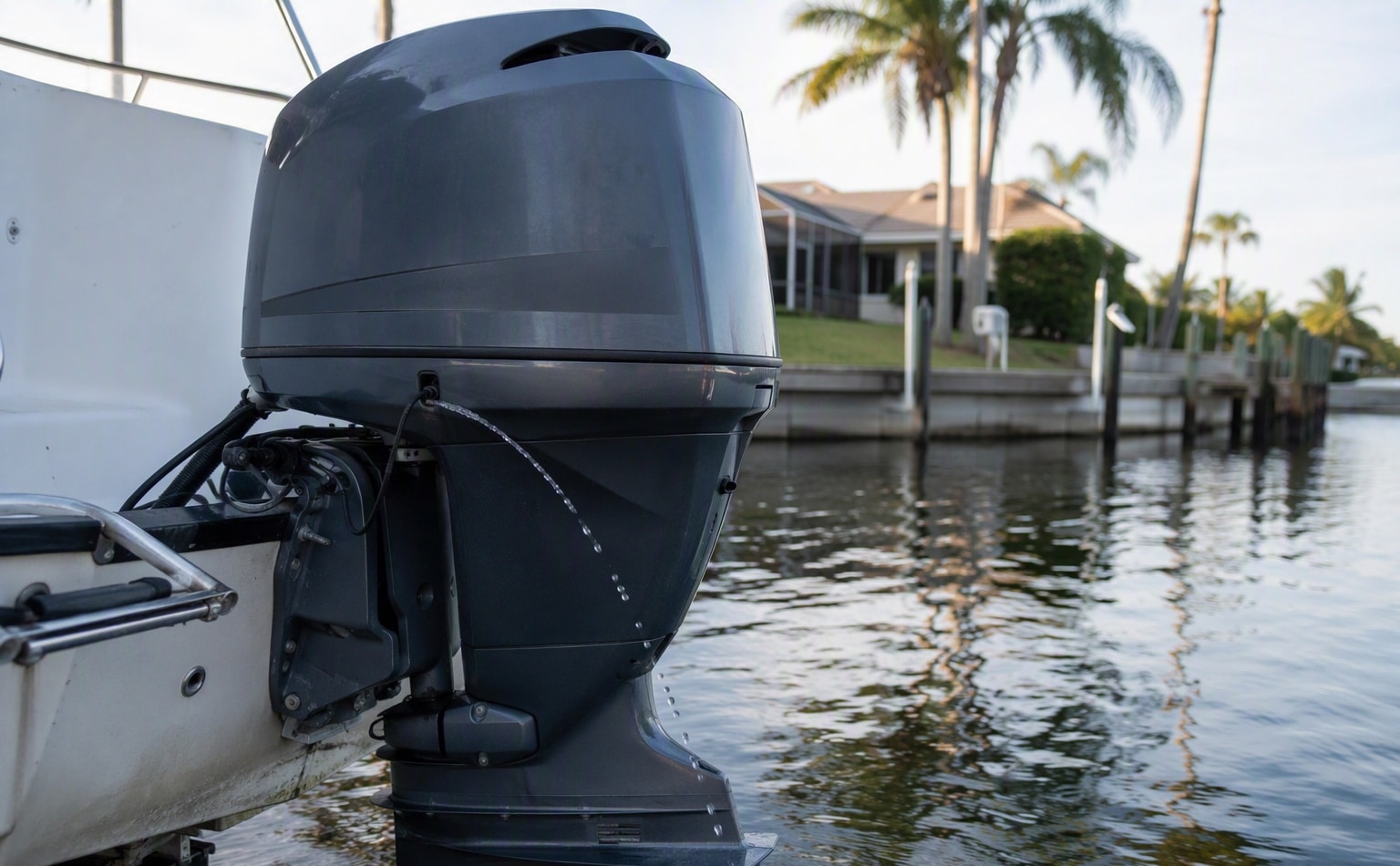
An outboard cools itself with the water it is floating in. There is no radiator and no reservoir. Raw water enters through intakes on the lower unit, gets pushed upward by a rubber impeller, circulates through passages cast into the powerhead, and exits through the exhaust and the telltale.
That telltale stream is not decoration. It is the only continuous evidence you have that the entire system is working, which is why watching it on every start is a habit worth building.
The system depends on three things: unobstructed intakes, a working impeller, and clear passages. All three are checked during scheduled outboard servicing. All three fail routinely.
The Five Causes, in Order of Frequency
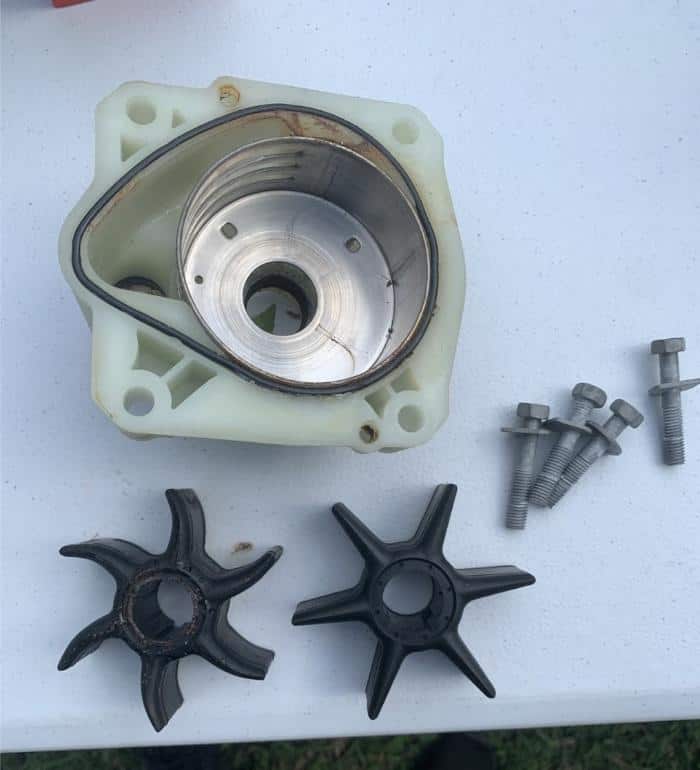
A worn impeller is first. It is rubber, it is a wear item, and it hardens and loses vane flexibility over time. A hard impeller moves less water at every RPM. It rarely fails suddenly, so the engine runs slightly warmer each season until the margin is gone.
Blocked intakes are second. Weed, plastic, silt from running shallow, or growth on a boat kept in a slip. Anything restricting the grates restricts everything downstream.
Salt restriction in the passages is third, and it is the one that ends powerheads. Salt crystals accumulate inside the water jackets over years, narrowing the passages. Nothing feels wrong until a hot day and a long run reveal that the margin disappeared some time ago.
A stuck thermostat is fourth. It holds temperature to a target, and stuck closed it holds temperature nowhere useful.
A failed pressure relief valve is fifth. Less common, same effect.
Why an Outboard Overheats
Outboards overheat when raw water flow through the powerhead is restricted. The usual causes in order are a worn water pump impeller, blocked lower unit intakes, salt build up in cooling passages, a stuck thermostat, and a failed pressure relief valve. Running hot for even a few minutes can score cylinders and fail head gaskets.
What Happens Inside a Hot Engine
Metal expands as it heats. That is fine within design limits and destructive outside them.
Pistons expand faster than the cylinder walls around them. Clearances that exist for lubrication vanish, the piston contacts the wall, and both surfaces score. A scored cylinder cannot seal, and a cylinder that cannot seal loses compression permanently.
Head gaskets fail because the surfaces they seal move relative to each other. Once a gasket goes, combustion pressure enters the cooling passages and coolant enters the chamber, and the engine degrades quickly from there.
Oil breaks down at high temperature and stops protecting bearings. Rubber seals harden. In extreme cases a powerhead seizes outright.
None of that repairs itself when the engine cools down. The damage is cumulative and permanent.
The Warning Signs Before the Alarm
The alarm is the last warning, not the first.
A weak, intermittent or absent telltale stream is the earliest and clearest sign, and it costs nothing to look at. What is blocking that flow is usually what salt water does to an outboard powerhead.
Steam or an unusual smell from under the cowling means it has already been hot.
Loss of power at cruise is a common symptom, because many engines protect themselves by reducing RPM before the alarm sounds. Owners often interpret that as a fuel problem.
A telltale stream that runs hot to the touch rather than cool is worth attention. So is any change from what that engine normally does, since normal varies between engines and you know yours.
What To Do When It Happens
Throttle back to idle immediately. Do not shut down instantly unless you must, because at idle the pump keeps circulating water and helps the engine cool in a controlled way.
Check the telltale. If there is no stream, shut down.
Check the intakes if you can reach them safely. Weed or a bag over a grate is a fixable problem on the water.
Do not restart repeatedly to get home. Every restart on a compromised cooling system adds damage, and a tow costs far less than a powerhead.
Have it assessed before the next use, even if it cooled down and seemed fine afterwards. Especially then, because an engine that ran hot once and got away with it is an engine with unknown internal condition.
What Ignoring It Actually Costs
An impeller is inexpensive and takes about an hour. Flushing salt restriction from passages is a modest job. A thermostat is a small part.
A scored cylinder means a rebuild. A failed head gasket, caught late, often means the same. A seized powerhead means replacement, and on many boats that approaches a meaningful percentage of what the whole rig is worth.
The gap between the cheapest prevention and the most expensive outcome on this particular fault is wider than on anything else an outboard does. That is the entire argument for taking a weak telltale seriously the first time you notice it.
The Boats Most at Risk
Three situations account for the majority of overheats we attend.
Boats kept permanently in a slip, because growth accumulates on intakes and the engine never gets a proper freshwater flush.
Boats used in shallow water, because silt and sand get drawn through the pump and accelerate impeller wear far beyond normal.
Boats bought used with no service history, because the internal condition of the cooling passages is genuinely unknown and the impeller age is whatever the previous owner says it is.
If your boat falls into any of those, the assessment is worth doing before a hot summer run rather than in response to one.
Why Idle Testing Misses It
A common frustration is an engine that overheats on the water and reads perfectly normal when checked at the dock.
That happens because restriction shows itself under demand. At idle the engine produces little heat and needs little flow, so a partially blocked passage or a tired impeller copes easily. At cruise the heat load multiplies and the same restriction cannot keep up.
This is why any meaningful cooling assessment measures temperature and flow under load rather than at idle, and why a clean bill of health from a dockside idle check is worth very little if the symptom appears at speed.
Prevention
Replace the impeller on schedule rather than on failure, and sooner than the schedule if the boat lives in salt water year round.
Flush after every salt trip, properly and for several minutes.
Watch the telltale on every start and know what normal looks like on your engine.
Have cooling passages assessed periodically on any boat more than a few years old in salt water, and immediately on any boat with unknown history.
If your engine has run hot or the telltale is weaker than it used to be, our outboard motor repair fort lauderdale service can test cooling flow and temperature under load at the dock. Call (305) 282-5283.