
Every outboard manufacturer publishes a service schedule, and every one of them was written for average conditions. South Florida is not average conditions.
The intervals in your owner’s manual assume moderate temperatures, seasonal use, and fresh or brackish water. Boats in Fort Lauderdale run in warm salt water, year round, often in short trips with long gaps between them. That combination is harder on an engine than the schedule anticipates, and owners who follow the book exactly are frequently surprised when something wears out early.
The Two Numbers That Matter
Outboard servicing is driven by hours and by time, and whichever comes first is the one that counts.
The hour intervals are familiar to most owners. A hundred hours is the standard major service point on most modern four strokes. The reason the interval matters so much here is what salt water does to a powerhead. Three hundred hours brings a deeper service. Between those, twenty hour and fifty hour checks catch small things before they become large ones.
The time interval is the one people ignore. Most manufacturers specify an annual service regardless of hours, and in Florida that is the interval that usually applies, because a great many boats here do not reach a hundred hours in a year. An engine that ran forty hours and then sat through a hot humid summer needs attention just as much as one that ran two hundred. That long idle stretch is exactly what produces a no-start after a long layup.
Why Heat Changes the Calculation
Heat degrades everything in an engine faster.
Oil breaks down more quickly at high operating temperatures, and a four stroke outboard in Florida runs hot for most of its life. Oil that would comfortably last a season in cooler water gives up sooner here, and oil that has given up stops protecting bearings and cylinder walls.
Rubber and plastic age faster. Fuel lines, primer bulbs, seals and impellers all harden and crack sooner in sustained heat, and an impeller is a part you do not want failing on a long run.
Fuel degrades faster. This is the big one for boats used infrequently. Warm ethanol blended fuel in a vented tank absorbs moisture through a humid summer, and a boat that sat from June to October is very often starting the season with fuel that will not burn properly.
How Often an Outboard Needs Servicing in Florida
In South Florida an outboard should be serviced every hundred hours or once a year, whichever comes first, and the annual interval is the one that usually applies because most boats here do not reach a hundred hours. Sustained heat degrades oil, rubber components and fuel faster than manufacturer schedules assume, so time based servicing matters more here than hour based servicing.
What a Hundred Hour Service Actually Includes
The hundred hour interval is the one most owners recognise, and it is worth knowing what it covers, because the difference between a real hundred hour service and an oil change with a nice invoice is substantial.
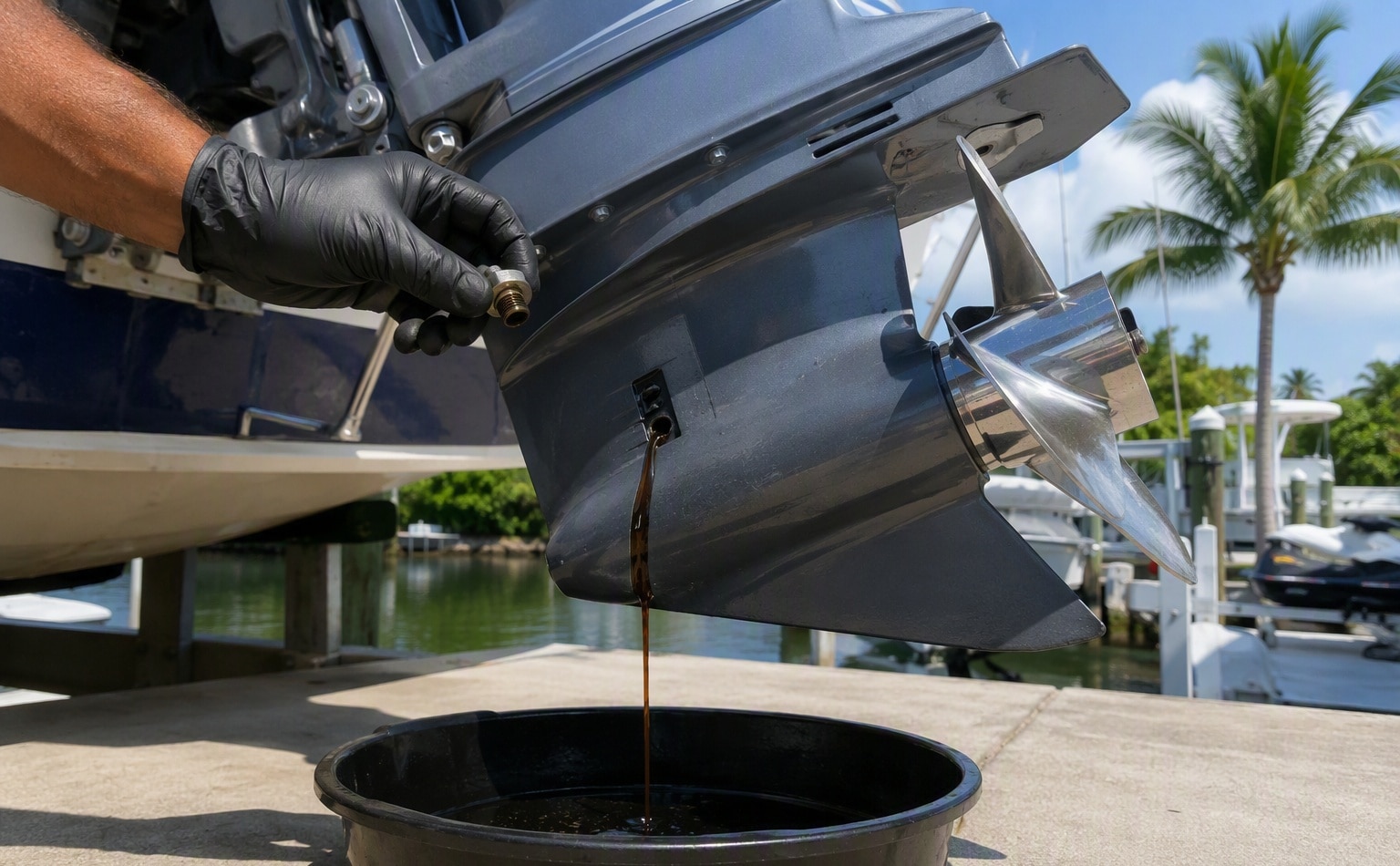
A proper service changes engine oil and filter, changes gear lube and inspects it for water intrusion, replaces spark plugs, inspects or replaces the water pump impeller, checks and cleans the thermostat, inspects fuel lines and filters, checks and replaces anodes as needed, lubricates the linkages and steering components, checks the battery and its connections, and verifies cooling flow and operating temperature under load.
That last item is worth paying attention to. An engine can pass every visual inspection and still be running hot because of a restriction you can only find by measuring.
We recently completed hundred hour servicing on a pair of Mercury 350 Verados and a three hundred hour service on a Yamaha, and in both cases the gear lube inspection was the most informative part of the job. It is the cheapest early warning of a seal problem that exists.
The Gap Between Trips Is the Real Enemy
Two boats with identical engines and identical hours can be in wildly different condition, and usage pattern is why.
A boat used every weekend keeps fuel fresh, keeps seals wet and moving, keeps the battery charged, and keeps salt from sitting undisturbed. A boat used once every six weeks does none of those things, and it accumulates problems while doing nothing at all.
If your boat sits for long stretches, the useful adjustment is not more frequent full services. It is short checks before each trip and strict discipline about fuel and flushing. Check the primer bulb, look at the telltale on start up, check the battery, and flush properly after every salt trip regardless of how short it was.
Signs You Are Overdue Regardless of the Calendar
Some symptoms override any schedule.
Milky or discoloured gear lube means water is getting into the lower unit, and that needs attention immediately rather than at the next interval. A weak or interrupted telltale stream means cooling flow is compromised. Hard starting after a layup usually means fuel. Rough running under load, unexplained fuel consumption, or a temperature alarm at any point all mean the same thing: stop using the schedule and get it looked at.
An engine that has run hot even once should be assessed before its next long run, not at its next service date.
What This Costs You If You Skip It
Deferred servicing is not saved money. It is borrowed money at a very poor rate.
An impeller costs little and takes an hour. An overheat caused by a failed impeller can score cylinders and cost a powerhead. Gear lube is inexpensive. A lower unit rebuild after water sat in it through a season is not. Fresh plugs and clean fuel filters are trivial. A no-start on the morning of a charter is not trivial at all.
The engines that reach high hours in South Florida are almost never the ones that had expensive work done. They are the ones that had cheap work done on time.
Two Boats, Same Engine, Different Outcomes
It is worth seeing how this plays out in practice, because the numbers are not close.
Take two identical four stroke outboards bought the same year. The first runs most weekends, gets flushed every time, and gets an annual service whether or not it reached a hundred hours. The second runs a dozen times a year, gets flushed when somebody remembers, and gets serviced when something feels wrong.
By year four the first engine has had four oil changes, four gear lube changes, two impellers and a set of anodes replaced annually. None of it was expensive and none of it was urgent. By year four the second engine has usually had one large bill: an overheat, a lower unit, or a fuel system strip after a long layup. That single bill is normally larger than four years of servicing on the first engine, and the engine is worth less afterwards.
The second owner did not save money by servicing less. He deferred a smaller cost into a bigger one and lost resale value doing it.
What to Ask Whoever Services Your Engine
Not all servicing is equal, and the questions worth asking are simple.
Ask what the gear lube looked like. If the answer is vague, the inspection was probably a drain and fill rather than a diagnostic. Ask what the operating temperature was under load, not at idle. Ask whether the impeller was inspected or replaced, and whether the housing showed salt build up. Ask what the plugs looked like when they came out, because plug condition tells you how the engine has been running better than almost anything else.
A technician who can answer those four questions specifically has actually serviced your engine. One who cannot has changed its oil.
Setting a Schedule That Works Here
Book an annual service and treat the date as fixed. Track hours and bring the service forward if you reach a hundred sooner. Flush after every salt trip. Check anodes twice a year. And if the boat is going to sit for more than a month, deal with the fuel before it sits rather than after.
If you want servicing done at the boat rather than at a shop, our outboard motor repair fort lauderdale service works at docks, marinas and driveways across the area. Call (305) 282-5283.