
There is one number that separates a used outboard worth buying from one that is about to become somebody’s expensive mistake, and it takes about twenty minutes to get.
A compression test measures what each cylinder can actually do. Everything else on a used boat can be cleaned, replaced or negotiated. Compression is the condition of the engine itself, and it is the one thing a seller cannot detail his way around. The other thing a seller cannot hide is signs a lower unit is taking on water.
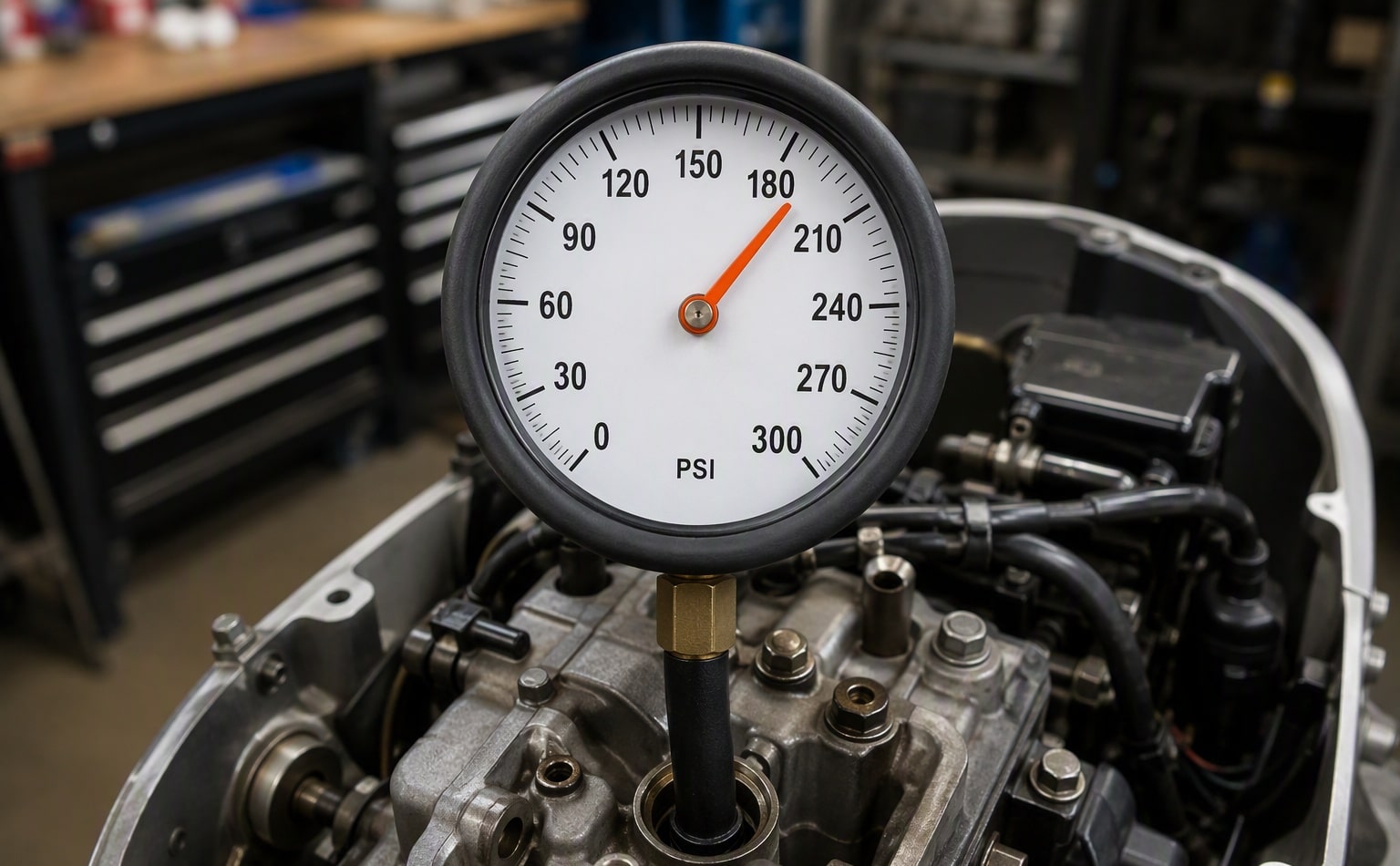
What the Test Actually Measures
A gauge threads into each spark plug hole in turn. The engine is cranked with the throttle open, and the gauge records the peak pressure that cylinder builds.
That pressure comes from the piston rings sealing against the cylinder wall, the valves sealing in a four stroke, and the head gasket holding the chamber closed. If any of those three is compromised, pressure escapes and the number drops. There is nowhere for a weak cylinder to hide.
The Numbers That Matter, and the One That Matters More
Absolute readings vary by engine, and a healthy figure on one design is mediocre on another. That is why the manufacturer’s specification matters and why a number quoted without context tells you very little.
What matters far more is the spread between cylinders. On a healthy engine every cylinder should read within roughly ten percent of the others. Uniformly low readings usually mean high hours, which feeds into what two stroke and four stroke owners really spend over a decade. Consistency indicates even wear across a powerhead that has been treated the same way throughout its life.
A single cylinder reading well below its neighbours is the finding that ends negotiations. It points at a specific failure in that cylinder: a broken or stuck ring, a scored wall, a burnt valve, or a head gasket leaking between chambers. None of those is a maintenance item. All of them mean the powerhead comes apart.
Uniformly low readings across every cylinder are a different story. That usually means general wear from high hours, and it tells you the engine is nearer the end of its life than the seller’s description implied.
What a Compression Test Tells You About a Used Boat
A compression test measures each cylinder’s sealing ability and reveals internal engine condition that no visual inspection can find. Cylinders should read within about ten percent of each other. One low cylinder indicates ring, valve or head gasket failure requiring powerhead work. Uniformly low readings indicate general wear from high hours.
Why Sellers Do Not Volunteer It
A boat can look immaculate and have a dying powerhead. Polish, new upholstery and clean bilges say nothing about what the pistons are doing.
An engine with a failing cylinder frequently starts fine, idles acceptably, and feels normal at the dock. The symptoms appear under load, at speed, over distance, which is exactly what does not happen during a five minute demonstration in a canal. Sellers who know this arrange short, gentle sea trials.
That is not always dishonesty. Plenty of owners genuinely do not know, because nobody ever tested it and the engine never gave them a reason to look. The point is that goodwill is not a substitute for a measurement.
The Test Has Limits, and You Should Know Them
Compression tells you a cylinder holds pressure. It does not tell you why it does or does not.
A leak-down test is the follow up when a number comes back low. It pressurises the cylinder and listens for where the air escapes. Air at the exhaust means an exhaust valve. Air at the intake means an intake valve. Air in the crankcase means rings. Bubbles in the coolant mean a head gasket. That distinction changes the repair cost substantially.
Compression also says nothing about the lower unit, the fuel system, the wiring, or corrosion inside the cooling passages. It is one test in a survey, not the survey.
What Else Belongs in a Pre-Purchase Inspection
Gear lube condition, because milky lube means water in the gear case and that is a separate expensive problem.
Cooling system condition, including operating temperature under load rather than at idle, because salt restriction is invisible until the engine is working.
Corrosion assessment, particularly around fasteners and the transom bracket, because seized hardware inflates the cost of every future repair.
Hours, verified against the engine’s own computer where possible rather than accepted from the seller.
Service history, including whether the boat was flushed after salt use. An owner who cannot answer that question has answered it.
The Survey That Ended Early
We were brought in on a 2022 outboard cruiser for a buyer. We identified problems from the start, photographed each one and explained what it meant, and then stopped the survey before completing it, because the boat was clearly not in a condition to sea trial.
Ending early saved the buyer the cost of finishing an inspection whose conclusion was already obvious. He also received estimated repair costs for what had been found, so his decision was made with real numbers rather than optimism.
That is the value of an inspection done properly. Not a certificate at the end, but a decision made on evidence, early enough to matter.
Reading a Test the Seller Already Has
Sometimes a seller hands you figures from a test done six months ago. They are worth something, but less than people assume.
Check the date first. Compression from a year ago describes an engine that has since run a season, possibly hard. Check whether every cylinder is listed. A sheet showing three numbers on a four cylinder engine is not a compression test, it is a selection. Check whether the readings look suspiciously identical, because real engines vary slightly and a set of four identical round numbers is usually someone’s memory rather than a gauge.
Ask who performed it. A test done by the selling dealer is not independent, and no reasonable seller objects to you confirming a good result.
What This Costs Against What It Saves
An inspection with compression testing costs a small fraction of a powerhead replacement, and a very small fraction of a boat purchase.
The asymmetry is the entire argument. If the engine tests well, you have paid a modest amount for certainty and a negotiating position. If it tests badly, you have avoided a bill that can approach a third of the boat’s value, or you have the evidence to renegotiate accordingly.
There is no version of this arithmetic where skipping the test comes out ahead.
Twin and Triple Installations
On a boat with more than one engine the test becomes more informative, not less, because you get a built in comparison.
Two engines that have lived on the same transom, run the same hours, and been maintained by the same owner should read broadly alike. When one reads consistently lower across all its cylinders, that engine has had a harder life or a problem the other has not, and it is worth asking why before assuming the pair are equivalent.
It also matters commercially. Buyers frequently price a twin rig as though both engines are in the same condition. If one needs work, that is a negotiating position on the whole boat rather than a small deduction.
How to Handle the Seller
Ask for compression figures before you view. A seller who has them ready is usually a seller who has maintained the boat.
If figures are offered without documentation, treat them as a claim rather than a fact and test independently. If a seller refuses an inspection outright, that is information, and it is rarely information in your favour.
Arrange the test before money changes hands, not after a deposit. A deposit changes the conversation and rarely for the better.
If you are looking at a used boat in the area and want the engine tested before you commit, our outboard motor repair fort lauderdale service performs pre-purchase inspections at the seller’s dock. Call (305) 282-5283.