
Almost every gallon of gasoline sold at a South Florida pump contains up to ten percent ethanol. For a car driven daily that is a non-event. For an outboard that sits in a vented tank for six weeks in summer humidity, it is the single most common cause of expensive problems.
The mechanism is not complicated and it is worth understanding, because almost all of the damage is avoidable by changing habits rather than parts.
Ethanol Attracts Water, and Boats Are Surrounded by It
Ethanol is hygroscopic, meaning it pulls moisture out of the air. Every fuel tank on a boat is vented, so the air above the fuel is the same warm humid air everything else is sitting in. The same heat and humidity drive how often an outboard needs servicing in Florida heat.
As the boat heats and cools each day, that air moves in and out of the tank, and every cycle brings moisture with it. The ethanol absorbs it. For a while the water stays suspended in the fuel and the engine runs on it without complaint.
Then It Separates, and That Is the Real Problem
Once the fuel absorbs more water than the ethanol can hold, it separates. That separation is the single most common reason for why an outboard cranks but will not start. This is called phase separation, and it is the point at which fuel stops being fuel.
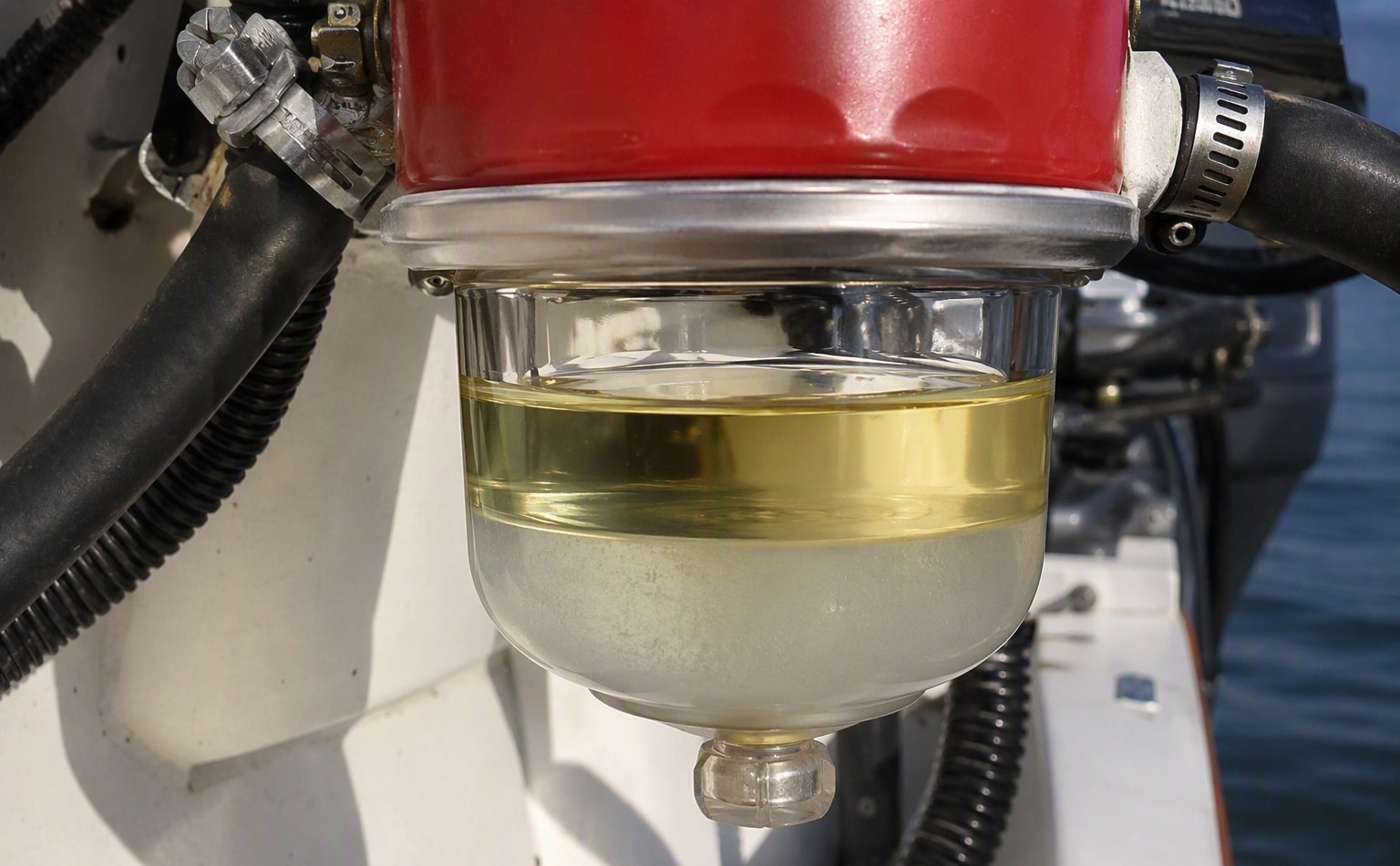
The mixture splits into two layers. On top sits gasoline that has lost much of its ethanol, and with it a chunk of its octane. On the bottom sits a layer of water and ethanol. Because the pickup tube draws from the bottom of the tank, the engine gets fed the water layer first.
That is why a boat that ran perfectly in June will not start in September. Nothing broke. The fuel simply became two things, and the engine is being handed the wrong one.
Phase separation is not reversible. No additive puts it back together. Once a tank has separated, the contents come out.
Ethanol Fuel and Outboards: What Actually Goes Wrong
Ethanol absorbs moisture from humid air in a vented tank, and once saturated the fuel separates into a gasoline layer and a water-ethanol layer. Because fuel is drawn from the bottom of the tank, the engine receives the water layer first, causing no-start and rough running. Separation is permanent and the fuel must be removed.
What It Does to the Fuel System Itself
Water in the system is the immediate problem. The longer term problem is what ethanol does to components.
Ethanol acts as a solvent. In older boats it dissolves varnish and deposits that decades of conventional fuel left behind, and carries that debris straight into filters, pumps and injectors. Owners of older boats often find their first ethanol related failure is a clogged filter rather than anything dramatic.
It also attacks rubber and certain plastics that predate ethanol compatible specifications. Fuel lines soften, swell and crack. Primer bulbs go hard. Older tank fittings and gaskets deteriorate. On a boat more than fifteen years old, the fuel system components themselves are frequently not rated for what is now being put through them.
Water in the system corrodes from the inside. Tanks, fuel rails and injectors are not designed to sit in water, and aluminium tanks in particular pit and eventually leak.
The Symptoms in the Order They Appear
Hard starting after a layup is usually the first sign, and the one most owners dismiss.
Rough idle and hesitation come next, particularly when the engine is asked for power quickly.
Stalling under load follows, because the engine can cope at idle on marginal fuel and cannot cope at three thousand RPM.
Filters clogging repeatedly is a strong tell. If you are replacing a fuel filter more than once a season, the problem is upstream in the tank, not the filter.
Visible water in the separator bowl is confirmation rather than warning. By the time it is collecting there, it has been in the tank a while.
Why Older Boats Suffer Worse
Two boats can sit side by side with the same fuel in them and have very different outcomes, and age is usually the reason.
Boats built before roughly the mid two thousands frequently have fuel lines, bulbs, tank fittings and gaskets that were specified before ethanol blends were standard. Those components were never designed for what is now in every tank, and they degrade from the inside where nothing is visible until something fails.
Older aluminium tanks are also more likely to have accumulated deposits and, in the worst cases, pitting from water that sat in the bottom over previous seasons. When ethanol strips those deposits loose, they move downstream all at once.
If your boat is older and has never had its fuel system components reviewed, that review is worth doing before the next long layup rather than after the no-start that follows it.
What Storage Actually Looks Like
Owners hear winterise and reasonably conclude it does not apply in Florida, where nothing freezes. The freezing is not the point. The sitting is.
A boat going unused for more than about six weeks benefits from the same preparation regardless of climate: fill the tank, add a stabiliser rated for ethanol, run the engine long enough for treated fuel to reach the carburettors or injectors, and flush thoroughly before it goes still.
That last step matters because the salt discussed elsewhere on this site and the fuel problem discussed here compound each other. A boat that sat with stale fuel and unflushed cooling passages has two problems waiting, and they tend to surface on the same morning.
What Actually Prevents It
Buy ethanol free fuel where it is available. Many marinas in South Florida sell it, it costs more, and for a boat that sits between uses it is cheaper than the alternative.
Keep the tank full when storing. A full tank has minimal air space, and minimal air space means minimal moisture. Half a tank through a Florida summer is an invitation.
Use a marine fuel stabiliser rated for ethanol, and add it when the fuel is fresh rather than when the boat has already sat. Stabiliser slows degradation. It does not repair fuel that has already gone.
Run the boat regularly. Fuel that gets used never has time to fail. This is why weekend boats rarely have fuel problems and infrequently used boats almost always do.
Fit and maintain a water separating filter, and actually check the bowl. It exists to tell you something.
If You Think Your Fuel Has Gone
Do not keep cranking. You will foul plugs and flatten a battery chasing a problem that is not electrical.
Do not add fresh fuel on top and hope for dilution. Mixing good fuel into separated fuel gives you a larger quantity of bad fuel.
Do not add an additive claiming to reverse separation. Nothing reverses it.
The tank needs draining and disposing of properly, the filters need replacing, and the lines need inspecting for the softening and cracking that often accompanies it. On a boat that has sat a long time, the injectors or carburettors may need cleaning as well, because whatever was in the tank has been through them.
If your boat has been sitting and will not start, our outboard motor repair fort lauderdale service handles fuel system work at the dock or in the driveway. Call (305) 282-5283.